PodSecurityPolicy: The Historical Context
The PodSecurityPolicy (PSP) admission controller has been removed, as of Kubernetes v1.25. Its deprecation was announced and detailed in the blog post PodSecurityPolicy Deprecation: Past, Present, and Future, published for the Kubernetes v1.21 release.
This article aims to provide historical context on the birth and evolution of PSP, explain why the feature never made it to stable, and show why it was removed and replaced by Pod Security admission control.
PodSecurityPolicy, like other specialized admission control plugins, provided fine-grained permissions on specific fields concerning the pod security settings as a built-in policy API. It acknowledged that cluster administrators and cluster users are usually not the same people, and that creating workloads in the form of a Pod or any resource that will create a Pod should not equal being "root on the cluster". It could also encourage best practices by configuring more secure defaults through mutation and decoupling low-level Linux security decisions from the deployment process.
The birth of PodSecurityPolicy
PodSecurityPolicy originated from OpenShift's SecurityContextConstraints (SCC) that were in the very first release of the Red Hat OpenShift Container Platform, even before Kubernetes 1.0. PSP was a stripped-down version of the SCC.
The origin of the creation of PodSecurityPolicy is difficult to track, notably because it was mainly added before Kubernetes Enhancements Proposal (KEP) process, when design proposals were still a thing. Indeed, the archive of the final design proposal is still available. Nevertheless, a KEP issue number five was created after the first pull requests were merged.
Before adding the first piece of code that created PSP, two main pull
requests were merged into Kubernetes, a SecurityContext subresource
that defined new fields on pods' containers, and the first iteration of the ServiceAccount
API.
Kubernetes 1.0 was released on 10 July 2015 without any mechanism to restrict the
security context and sensitive options of workloads, other than an alpha-quality
SecurityContextDeny admission plugin (then known as scdeny).
The SecurityContextDeny plugin
is still in Kubernetes today (as an alpha feature) and creates an admission controller that
prevents the usage of some fields in the security context.
The roots of the PodSecurityPolicy were added with the very first pull request on security policy, which added the design proposal with the new PSP object, based on the SCC (Security Context Constraints). It was a long discussion of nine months, with back and forth from OpenShift's SCC, many rebases, and the rename to PodSecurityPolicy that finally made it to upstream Kubernetes in February 2016. Now that the PSP object had been created, the next step was to add an admission controller that could enforce these policies. The first step was to add the admission without taking into account the users or groups. A specific issue to bring PodSecurityPolicy to a usable state was added to keep track of the progress and a first version of the admission controller was merged in pull request named PSP admission in May 2016. Then around two months later, Kubernetes 1.3 was released.
Here is a timeline that recaps the main pull requests of the birth of the PodSecurityPolicy and its admission controller with 1.0 and 1.3 releases as reference points.
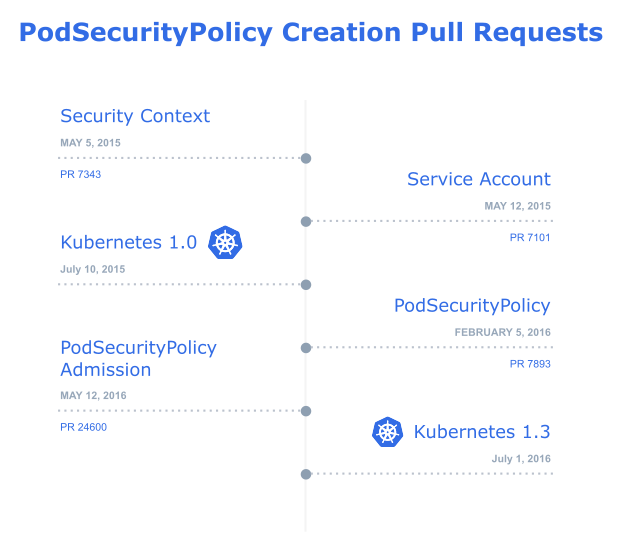
After that, the PSP admission controller was enhanced by adding what was initially left aside. The authorization mechanism, merged in early November 2016 allowed administrators to use multiple policies in a cluster to grant different levels of access for different types of users. Later, a pull request merged in October 2017 fixed a design issue on ordering PodSecurityPolicies between mutating and alphabetical order, and continued to build the PSP admission as we know it. After that, many improvements and fixes followed to build the PodSecurityPolicy feature of recent Kubernetes releases.
The rise of Pod Security Admission
Despite the crucial issue it was trying to solve, PodSecurityPolicy presented some major flaws:
- Flawed authorization model - users can create a pod if they have the use verb on the PSP that allows that pod or the pod's service account has the use permission on the allowing PSP.
- Difficult to roll out - PSP fail-closed. That is, in the absence of a policy, all pods are denied. It mostly means that it cannot be enabled by default and that users have to add PSPs for all workloads before enabling the feature, thus providing no audit mode to discover which pods would not be allowed by the new policy. The opt-in model also leads to insufficient test coverage and frequent breakage due to cross-feature incompatibility. And unlike RBAC, there was no strong culture of shipping PSP manifests with projects.
- Inconsistent unbounded API - the API has grown with lots of inconsistencies notably because of many requests for niche use cases: e.g. labels, scheduling, fine-grained volume controls, etc. It has poor composability with a weak prioritization model, leading to unexpected mutation priority. It made it really difficult to combine PSP with other third-party admission controllers.
- Require security knowledge - effective usage still requires an understanding of Linux security primitives. e.g. MustRunAsNonRoot + AllowPrivilegeEscalation.
The experience with PodSecurityPolicy concluded that most users care for two or three policies, which led to the creation of the Pod Security Standards, that define three policies:
- Privileged - unrestricted policy.
- Baseline - minimally restrictive policy, allowing the default pod configuration.
- Restricted - security best practice policy.
The replacement for PSP, the new Pod Security Admission is an in-tree, stable for Kubernetes v1.25, admission plugin to enforce these standards at the namespace level. It makes it easier to enforce basic pod security without deep security knowledge. For more sophisticated use cases, you might need a third-party solution that can be easily combined with Pod Security Admission.
What's next
For further details on the SIG Auth processes, covering PodSecurityPolicy removal and creation of Pod Security admission, the SIG auth update at KubeCon NA 2019 and the PodSecurityPolicy Replacement: Past, Present, and Future presentation at KubeCon NA 2021 records are available.
Particularly on the PSP removal, the PodSecurityPolicy Deprecation: Past, Present, and Future blog post is still accurate.
And for the new Pod Security admission, documentation is available. In addition, the blog post Kubernetes 1.23: Pod Security Graduates to Beta along with the KubeCon EU 2022 presentation The Hitchhiker's Guide to Pod Security give great hands-on tutorials to learn.