This article is more than one year old. Older articles may contain outdated content. Check that the information in the page has not become incorrect since its publication.
Kubernetes v1.33: Image Pull Policy the way you always thought it worked!
Image Pull Policy the way you always thought it worked!
Some things in Kubernetes are surprising, and the way imagePullPolicy behaves might
be one of them. Given Kubernetes is all about running pods, it may be peculiar
to learn that there has been a caveat to restricting pod access to authenticated images for
over 10 years in the form of issue 18787!
It is an exciting release when you can resolve a ten-year-old issue.
Note:
Throughout this blog post, the term "pod credentials" will be used often. In this context, the term generally encapsulates the authentication material that is available to a pod to authenticate a container image pull.IfNotPresent, even if I'm not supposed to have it
The gist of the problem is that the imagePullPolicy: IfNotPresent strategy has done
precisely what it says, and nothing more. Let's set up a scenario. To begin, Pod A in Namespace X is scheduled to Node 1 and requires image Foo from a private repository.
For it's image pull authentication material, the pod references Secret 1 in its imagePullSecrets. Secret 1 contains the necessary credentials to pull from the private repository. The Kubelet will utilize the credentials from Secret 1 as supplied by Pod A
and it will pull container image Foo from the registry. This is the intended (and secure)
behavior.
But now things get curious. If Pod B in Namespace Y happens to also be scheduled to Node 1, unexpected (and potentially insecure) things happen. Pod B may reference the same private image, specifying the IfNotPresent image pull policy. Pod B does not reference Secret 1
(or in our case, any secret) in its imagePullSecrets. When the Kubelet tries to run the pod, it honors the IfNotPresent policy. The Kubelet sees that the image Foo is already present locally, and will provide image Foo to Pod B. Pod B gets to run the image even though it did not provide credentials authorizing it to pull the image in the first place.
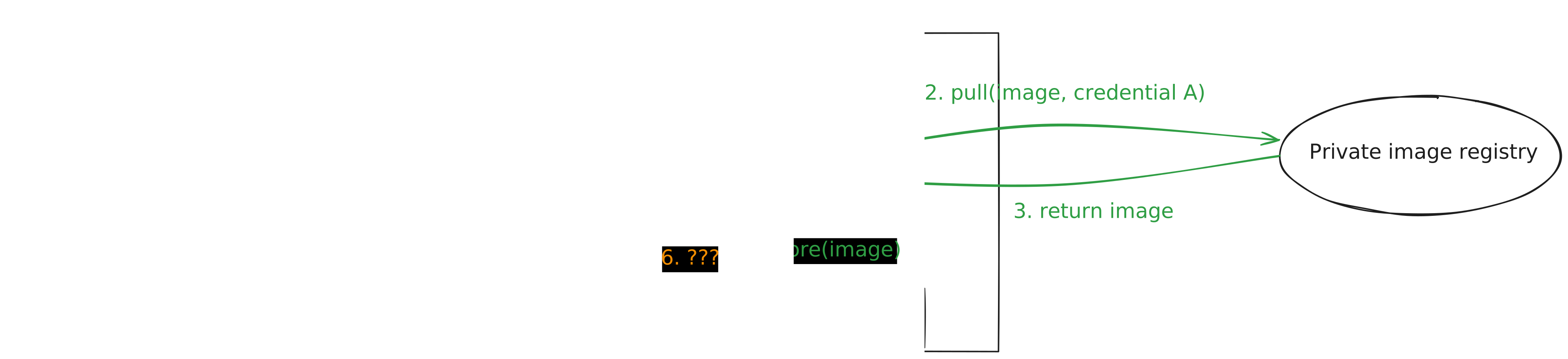
Using a private image pulled by a different pod
While IfNotPresent should not pull image Foo if it is already present
on the node, it is an incorrect security posture to allow all pods scheduled
to a node to have access to previously pulled private image. These pods were never
authorized to pull the image in the first place.
IfNotPresent, but only if I am supposed to have it
In Kubernetes v1.33, we - SIG Auth and SIG Node - have finally started to address this (really old) problem and getting the verification right! The basic expected behavior is not changed. If an image is not present, the Kubelet will attempt to pull the image. The credentials each pod supplies will be utilized for this task. This matches behavior prior to 1.33.
If the image is present, then the behavior of the Kubelet changes. The Kubelet will now verify the pod's credentials before allowing the pod to use the image.
Performance and service stability have been a consideration while revising the feature. Pods utilizing the same credential will not be required to re-authenticate. This is also true when pods source credentials from the same Kubernetes Secret object, even when the credentials are rotated.
Never pull, but use if authorized
The imagePullPolicy: Never option does not fetch images. However, if the
container image is already present on the node, any pod attempting to use the private
image will be required to provide credentials, and those credentials require verification.
Pods utilizing the same credential will not be required to re-authenticate. Pods that do not supply credentials previously used to successfully pull an image will not be allowed to use the private image.
Always pull, if authorized
The imagePullPolicy: Always has always worked as intended. Each time an image
is requested, the request goes to the registry and the registry will perform an authentication
check.
In the past, forcing the Always image pull policy via pod admission was the only way to ensure
that your private container images didn't get reused by other pods on nodes which already pulled the images.
Fortunately, this was somewhat performant. Only the image manifest was pulled, not the image. However, there was still a cost and a risk. During a new rollout, scale up, or pod restart, the image registry that provided the image MUST be available for the auth check, putting the image registry in the critical path for stability of services running inside of the cluster.
How it all works
The feature is based on persistent, file-based caches that are present on each of the nodes. The following is a simplified description of how the feature works. For the complete version, please see KEP-2535.
The process of requesting an image for the first time goes like this:
- A pod requesting an image from a private registry is scheduled to a node.
- The image is not present on the node.
- The Kubelet makes a record of the intention to pull the image.
- The Kubelet extracts credentials from the Kubernetes Secret referenced by the pod as an image pull secret, and uses them to pull the image from the private registry.
- After the image has been successfully pulled, the Kubelet makes a record of the successful pull. This record includes details about credentials used (in the form of a hash) as well as the Secret from which they originated.
- The Kubelet removes the original record of intent.
- The Kubelet retains the record of successful pull for later use.
When future pods scheduled to the same node request the previously pulled private image:
- The Kubelet checks the credentials that the new pod provides for the pull.
- If the hash of these credentials, or the source Secret of the credentials match the hash or source Secret which were recorded for a previous successful pull, the pod is allowed to use the previously pulled image.
- If the credentials or their source Secret are not found in the records of successful pulls for that image, the Kubelet will attempt to use these new credentials to request a pull from the remote registry, triggering the authorization flow.
Try it out
In Kubernetes v1.33 we shipped the alpha version of this feature. To give it a spin,
enable the KubeletEnsureSecretPulledImages feature gate for your 1.33 Kubelets.
You can learn more about the feature and additional optional configuration on the concept page for Images in the official Kubernetes documentation.
What's next?
In future releases we are going to:
- Make this feature work together with Projected service account tokens for Kubelet image credential providers which adds a new, workload-specific source of image pull credentials.
- Write a benchmarking suite to measure the performance of this feature and assess the impact of any future changes.
- Implement an in-memory caching layer so that we don't need to read files for each image pull request.
- Add support for credential expirations, thus forcing previously validated credentials to be re-authenticated.
How to get involved
Reading KEP-2535 is a great way to understand these changes in depth.
If you are interested in further involvement, reach out to us on the #sig-auth-authenticators-dev channel on Kubernetes Slack (for an invitation, visit https://slack.k8s.io/). You are also welcome to join the bi-weekly SIG Auth meetings, held every other Wednesday.