# How the controller-runtime Cache Actually Works, and Why Your Controller Does Not Crash the API Server
LLMS index: [llms.txt](/llms.txt)
---
This article has been revised since it was first published, to correct several significant technical inaccuracies in the original text.
Kubernetes has long been the default platform for distributed workloads, and writing your own
controller for it is now a matter of a few hours. The common path — Golang, using `kubebuilder` on top of
`controller-runtime` — gives you a project scaffold, types, and a reconciler. For typical
scenarios that is more than enough. But as soon as load grows or the controller starts behaving
in ways you did not expect, a whole class of edge cases shows up. Most of them trace back to
the same root cause: a fuzzy mental model of how `controller-runtime` works inside. If you
write Kubernetes controllers in Go, this article should help you build a coherent picture and
avoid expensive surprises in production.
This article walks through the internals of `controller-runtime` and, along the way, shows which
architectural decisions are baked into Kubernetes itself. The starting point is how
controllers actually read objects from the Kubernetes API.
A common misconception goes like this: `r.Get()` inside `Reconcile` queries `kube-apiserver`
directly; `r.List()` returns a fresh, live view of the world; and after `r.Update()` you can
re-read the object and immediately see the new state. In practice the model is the opposite:
`controller-runtime` operates against a local copy of the data populated through **list** + **watch**.
Reads inside a reconciler cost almost nothing and do not load the control plane even at
hundreds of calls per second — but the price of this design is that a controller can quietly
consume gigabytes of memory, perform hidden O(n) scans, and regularly trip over stale reads.
This post is aimed at engineers who already write controllers in Go with `controller-runtime`
but want to consolidate the pieces into a single mental model rather than carry around a bag
of isolated observations. The focus is the practical impact on production clusters: memory,
network traffic, read consistency, and reconciler behavior.
## TL;DR
If you take only one idea from this article, take this:
`r.Get()` and `r.List()` inside a reconciler typically do not read from the API server. They
read from a local in-memory cache, which the manager warms up with **list** and then keeps
current through **watch**.
Almost every other property of the system follows from that one fact:
- Reads are cheap, but not strongly consistent immediately after a write.
- Writes go straight to the API server, not through the cache.
- The size of the local cache and the set of indexes directly drive memory consumption.
- An incorrectly written `List()` can silently turn into a linear scan over tens of thousands
of objects.
- `APIReader` is rarely needed — but in some places you really cannot do without it.
The rest of the article unpacks why this is so and how the model is wired underneath.
## A bit of context: what a reconciliation loop is
To avoid arguments about terminology, start with the basic model.
A controller in Kubernetes lives inside a reconciliation loop: it continuously compares the
desired state of an object with the actual state and tries to bring one in line with the
other. The idea is described in the original
[architectural notes](https://github.com/kubernetes/design-proposals-archive/blob/main/architecture/principles.md)
on Kubernetes. In practice it looks like this:
- A user or another controller mutates an object.
- An event lands in a queue.
- `Reconcile` reads the current state.
- The controller decides what to create, update, or delete.
- The system produces a new event and the loop repeats.
What matters here is not that the controller "does something" — it is **where it learns about
changes from** and **where it reads state from**. That is exactly where the cache comes in.
On a live cluster, the easiest way to see this in action is:
```bash
kubectl get pods --watch
```
In watch mode, `kubectl` subscribes to the same event stream that controllers consume.
You create or delete a Pod and you see not a single "final" object but a chain of states: the
scheduler assigns a node, the kubelet updates status, other controllers contribute their
changes. Kubernetes controllers do not poll continuously — they consume an event stream and
maintain a local state that is kept current.
For a visual walkthrough, see [Reconciliation loop pattern in visual representation](https://www.youtube.com/watch?v=P50otWVh7w4),
a talk that shows how the reconciliation loop plays out on a real Pod and the states it
passes through.
## Why the cache exists in `controller-runtime` at all
Imagine the simplest possible controller:
```go
func (r *Reconciler) Reconcile(ctx context.Context, req ctrl.Request) (ctrl.Result, error) {
var pod corev1.Pod
if err := r.Get(ctx, req.NamespacedName, &pod); err != nil {
return ctrl.Result{}, err
}
// ... meaningful logic ...
}
```
Looks straightforward. But what happens when you call `r.Get`? Does it fire an HTTP request at
the API server? If it did, picture the scene: a dozen controllers, each issuing a **get** and
a **list** per reconcile, with hundreds of reconciles per second. The API server and `etcd`
would be writing each other farewell letters within minutes.
To prevent that, Kubernetes was built around a _watch model_ rather than polling from the
very beginning. The standard mechanism works like this: a client takes a snapshot of the slice
of the world it cares about once, then subscribes to a stream of changes and keeps a local copy
current. This is the **list** + **watch** pattern, and there is no "what is in the world right
now?" loop anywhere in it.
This idea has lived in `client-go` since the very first controllers in
`kube-controller-manager`. `controller-runtime` wraps it in a friendly framework so
that you do not have to glue the `Reflector`, the delta queue, and the `Indexer` together
yourself (more on those below).
So when people talk about "the controller-runtime cache", they are not talking about a clever
optimization. They are describing the foundation of the entire model: you read from memory,
you write to the API server, and you receive feedback through a watch.
The rest of this article walks through how each piece is wired up.
## Glossary
A few terms collected up front, so you do not have to jump back and forth later. Skim or skip
if any of them are already familiar.
- **GVK (GroupVersionKind)** — the triple that uniquely identifies an API type in
Kubernetes: group, version, and kind, for example `apps/v1/Deployment`. Almost every API in
`controller-runtime` works in terms of GVK rather than the name you would type in `kubectl`
(such as `deployments`).
- **resourceVersion** — a [monotonic counter](/docs/reference/using-api/api-concepts/#resource-versions)
that the API server tracks automatically, and that changes every time the object is written.
Although it's a decimal number, the field is represented as a string.
Resource versions serve two main purposes. The first one, you can use them for
*optimistic concurrency control* (for example: on **update**, the API server checks
that the `resourceVersion` you provide matches the one in `etcd`, otherwise it
returns `409 Conflict`). The second place you are going to see resource versions
in your controller is to resume a **watch**. Read
[watch bookmarks](/docs/reference/using-api/api-concepts/#watch-bookmarks) to learn
more.
- **Manager** — the `ctrl.Manager` object in `controller-runtime`. This is what your controller
constructs in `main.go` and runs through `mgr.Start(ctx)`. It orchestrates everything: it
owns the shared cache, builds the client, starts controllers, webhooks, the healthz
endpoint, and other runnables. A single process usually has exactly one manager, with many
controllers living inside it.
- **Informer** — an entity from `client-go` that maintains a watch on a single GVK, keeps an
indexed local store, and dispatches events to subscribers. In `controller-runtime` an
informer is created automatically when you register `Watches(...)` or perform the first
`Get`/`List` on a given type.
- **Store** — the in-memory backing store of an informer, where the objects themselves live.
Each informer in `controller-runtime` has its own store.
- **ResourceEventHandler** — an interface with three methods: `OnAdd`, `OnUpdate`, `OnDelete`.
The informer calls them for every event delivered through the delta queue. The store is
always updated before the handler runs, so a handler never sees an indexer that is behind
its own event. Subscribers (your controllers) register handlers like this and learn about
changes through them.
- **workqueue** — a queue of reconcile requests (`namespace/name`) with deduplication and rate
limiting. On every event the controller enqueues a request; workers pop them one at a time
and hand them to `Reconcile` as a `ctrl.Request`.
- **Predicate** — a controller-side filter. A predicate decides whether an event should be
enqueued at all (for example, "react only to changes in `spec`, ignore `status`").
With those in hand, you can dive in.
## Anatomy: what lives under the cache package
If you peek into `sigs.k8s.io/controller-runtime/pkg/cache`, you will see that it is a thin
wrapper over `k8s.io/client-go/tools/cache`. The same primitives that power the rest of
Kubernetes live underneath:
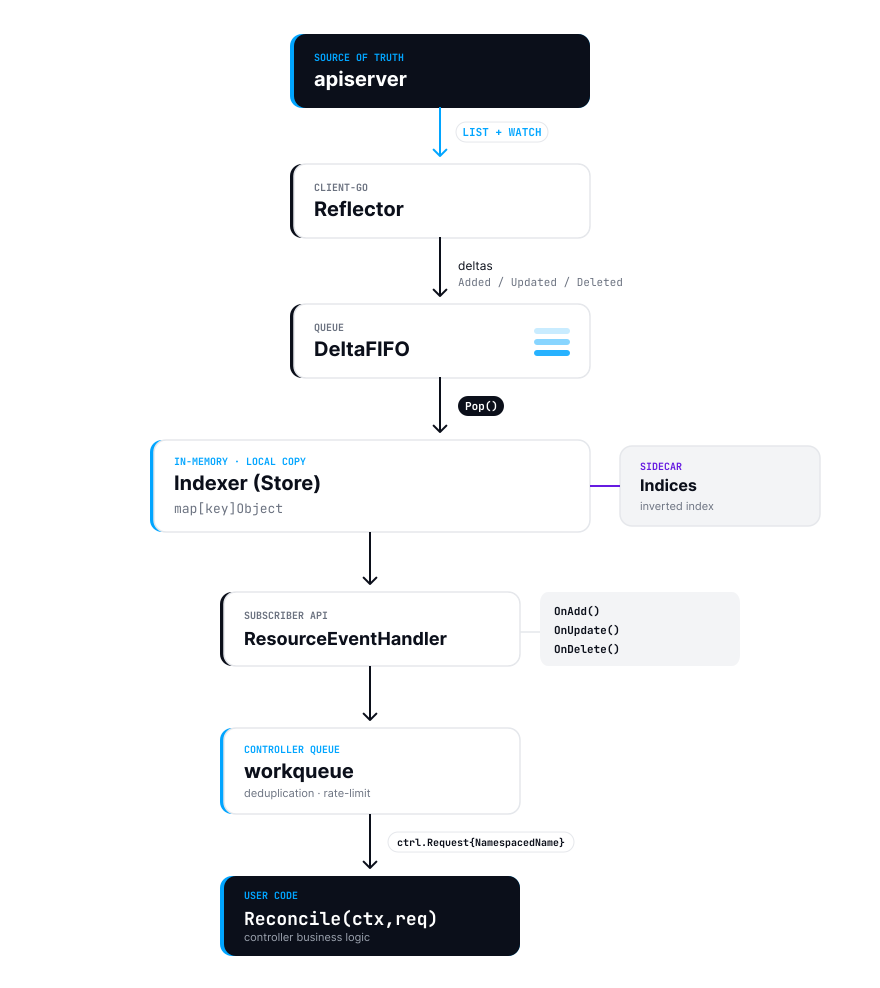
- **Reflector** — keeps a **watch** open against the API server and writes incoming changes
into a queue as _deltas_. A delta is a record of the form "object X received an `Added` /
`Updated` / `Deleted` event, and here is its new version". Effectively a single line in a
change log.
- The **delta queue** (`RealFIFO`, or `DeltaFIFO` on older client-go) — holds those deltas in
arrival order until the informer processes them.
- **Indexer (Store)** — the in-memory object store, plus the indexes built over it.
- **SharedIndexInformer** — the conductor that ties everything together and dispatches events
to subscribers — your controllers and any other observers.
At a glance the pipeline looks like this:
Pipeline diagram: API server to Reflector to the delta queue to Indexer to Event handlers
Now walk through each link.
### Reflector and resourceVersion
Within the cache, the Reflector is the only component that talks to the API server. It has
exactly two jobs: fetch the initial snapshot at startup, then keep a **watch** open from there
on. (Writes and `APIReader` reads bypass the cache entirely and reach the API server on their
own — more on those later.)
This is where the `resourceVersion` earns its keep. Along with the objects, the API server
reports the version at which the snapshot was produced. The Reflector then says to the API
server, "open a **watch** from version X", and receives a stream of events for everything that
happened after that version. That is the basis of consistency: there is no gap between the
snapshot and the stream, because the stream resumes exactly where the snapshot ended.
That snapshot no longer arrives as a separate **list** call by default. Current versions use a
[streaming list](/docs/reference/using-api/api-concepts/#streaming-lists) instead: the Reflector
opens the **watch** with `sendInitialEvents=true`, and the API server begins the stream with
synthetic `ADDED` events for the whole current state before switching to live changes. One
request instead of two, and a plain **list** as the fallback. The pattern is unchanged —
snapshot, then stream — which is why this article keeps saying **list** + **watch**, the way the
Kubernetes documentation does.
If the connection drops, the Reflector reconnects with the last known `resourceVersion`. If
the API server replies with `410 Gone` ("that version is no longer in the history, you are
too far behind"), the Reflector fetches a fresh snapshot and starts over. This is called a
_relist_, and it does not happen on a schedule — only in those failure scenarios.
### The delta queue
This piece is worth pausing on, and it is also the piece that changed most recently.
Historically the buffer between the Reflector and the rest of the informer was `DeltaFIFO`,
which held deltas in a map keyed by `namespace/name`: deltas for one object accumulated in a
slot, `Pop()` handed back the whole slice for that key at once, and a `dedupDeltas` helper
collapsed consecutive `Deleted` entries. If you have read about informer internals before,
that is probably the picture you are carrying.
That is no longer the default. Shared informers now use `RealFIFO`, and since client-go 1.36
`DeltaFIFO` cannot be switched back on at all. Which version you compile against is what
decides this, not the version of the cluster you point at. The new queue is deliberately
simpler — a flat, strictly ordered slice of deltas:
```go
type RealFIFO struct {
// ...
items []Delta
}
```
Its own documentation states the design goal plainly: every notification from the Reflector is
passed, in order, through `Pop`. Which means:
1. **Order is preserved globally**, not just per object. Deltas come out in exactly the
sequence they arrived.
2. **One `Pop`, one delta.** There is no per-key slot and no slice — `Pop` takes
`items[0]`. (There is also a `PopBatch` for processing several deltas in one pass, on by
default since client-go 1.35, but it is a batching optimization, not a merge: each delta is
still delivered.)
3. **No deduplication whatsoever.** `RealFIFO` has no `dedupDeltas` equivalent. Nothing is
collapsed — including consecutive deletes, and including intermediate states.
So the worked example gets simpler than it used to be. Suppose three events for
`default/my-deploy` arrive in quick succession:
1. `Added` — the Deployment is created (say, with `spec.replicas=1`).
2. `Updated` — somebody bumps `spec.replicas` to `2`.
3. `Updated` — and immediately to `3`.
All three are appended to the queue and popped one at a time, and the informer dispatches them
in order: first `OnAdd`, then two `OnUpdate` calls (the intermediate `1→2`, then the final
`2→3`). The event handler runs three times, no shortcuts.
The store is written *before* the handlers are notified, and handler delivery is asynchronous — the informer writes the indexer, then hands the
notification to a per-subscriber buffer that the subscriber's own goroutine drains later. So
your handler never sees an indexer lagging behind its own event, but it can see one that has
moved well past it. Handling the `1→2` update, a `Get` from the cache can legitimately
return `3` — or `NotFound`, if the object has since been deleted. Never treat the object in the
store as "the state at the time of my event".
Deduplication does exist — but it lives one layer up, in the controller's workqueue, and with
`RealFIFO` that is now the *only* place it happens. The mechanic is straightforward: for each
delta, the controller's event handler extracts the `namespace/name` _key_ from the object and
enqueues it. Re-inserting the same key silently coalesces with the existing entry; the
workqueue does not care about the object itself.
A concrete picture: you create a Pod. Within a second or two a flurry of `Updated` deltas
arrives — the scheduler assigns a node, the kubelet sets `Pending`, then `ContainerCreating`,
`Running`, `Ready`. Five deltas in a row, and the event handler fires on every one of them —
but throughout this window the workqueue holds a single entry with the key `default/my-pod`.
By the time `Reconcile` pops it, the cache already holds the final state, and `Reconcile`
runs once.
So you get two layers with cleanly separated responsibilities:
- The **delta queue** — an ordered stream of change facts, delivered one at a time and
without merging. Its job is to tell consumers everything that happened, in the right order.
- **workqueue** — a queue of **keys** with deduplication. This is the layer
that collapses "ten updates in a row → a reconcile or two".
If you keep that two-layer picture in your head, it becomes clear why a flood of events
against a single object barely affects controller throughput — the workqueue absorbs them.
### Indexer: the local copy of the cluster
The Indexer, backed by a `ThreadSafeStore`, is the local copy of the cluster. Underneath
it is a plain `map[string]interface{}` keyed by `namespace/name`, plus a single
`sync.RWMutex`, plus a dictionary of registered indexes (covered in their own section below).
An uncontended `r.Get` is cheap: a map lookup followed by a `DeepCopy` of the object. The
part of that structure that matters most at scale, though, is not the map — it is the one
`sync.RWMutex`, which guards the store and every index at once. Readers hold it for shared
access, the informer needs it exclusively to write, so the two genuinely compete: a `List`
holds the read lock while it walks every object of that kind, and the next store write waits
behind that walk. This was a real bottleneck in `kube-controller-manager` at scale
([kubernetes#130767](https://github.com/kubernetes/kubernetes/issues/130767)); recent
client-go releases hold the write lock for much less time.
### SharedIndexInformer and subscriptions
A SharedIndexInformer fuses the Reflector, the delta queue, and the Indexer together and
exposes two interfaces to the rest of the world:
- Read objects directly from the indexer.
- Register a `ResourceEventHandler` and receive notifications for every event coming out of
the queue — `OnAdd`, `OnUpdate`, `OnDelete`. The store is written before the handler call,
so by the time your handler runs the indexer already reflects that event, and possibly
later ones too.
"Outside" here means your controllers. When a controller registers `Watches(...)`, under the
hood it asks the informer: "add a handler that, on every change, enqueues the key into my
workqueue". The controller's workers then pop keys one at a time and call your
`Reconcile(ctx, ctrl.Request{NamespacedName: ...})`.
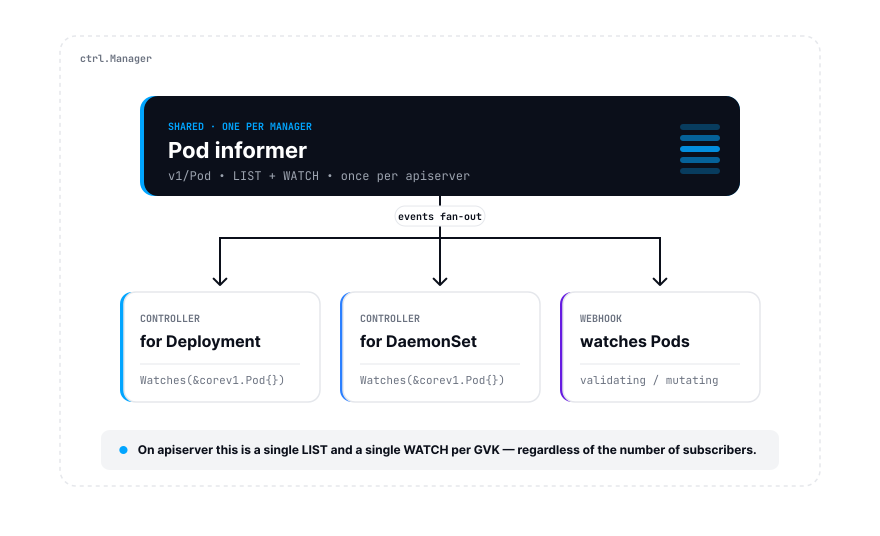
The keyword in the name is **Shared**. The manager creates **one** informer per GVK, and
every controller, webhook, and event source within that manager subscribes to it:
Shared informer diagram: a single list / watch per GVK, feeding multiple subscribers
In other words: an informer is the thing that subscribed to Pods once, holds them locally,
and serves every interested party in the process. From the API server's perspective, that is
one snapshot and one **watch** per GVK, regardless of how many reconcilers live inside your
process.
## What happens at startup and on the very first `r.Get`
Step by step, here is what happens between the moment the manager starts and the first
`r.Get` inside your reconciler:
1. The manager's `mgr.Start(ctx)` brings up every registered informer.
2. For each GVK, the Reflector fetches a full snapshot: every object of that type that falls
within your scope.
3. The snapshot is loaded into the informer's store, registered indexes are rebuilt, and the
informer is marked as synced.
4. The same stream then continues as an ordinary **watch** from the `resourceVersion` the
snapshot synced to.
5. **Only then** does the controller start invoking `Reconcile` — specifically, once every
source it owns reports synced, which includes its event handlers having processed the
initial snapshot. Until that point, workers do not drain the workqueue, even if events have
already started piling up.
So "the reconciler is running but the cache is still empty" is **not a state you can
observe** — the warm-up happens before the first `Reconcile`. (The one exception: a `Get` for a
type nothing registered a watch for starts a new informer on the spot, and blocks until it is
warm.)
What happens during the first `r.Get`? Suppose your reconciler contains:
```go
var obj appsv1.Deployment
err := r.Get(ctx, req.NamespacedName, &obj)
```
Under the hood it boils down to roughly this:
```go
item, exists, err := indexer.GetByKey("default/my-deploy")
if !exists {
return apierrors.NewNotFound(...)
}
// DeepCopy into obj
```
No HTTP, no TLS, no protobuf serialization, no `etcd`. A map lookup plus a deep copy of the
object, and no I/O at all.
To repeat, because it matters: even the very first `Get` for a registered type reads from a
fully warmed-up, fully indexed snapshot. There is no "first time slow, then fast".
**Note:** This applies specifically to `mgr.GetClient()`. If for some reason you need to
read objects **before** `mgr.Start()` (for example, during initialization), use
`mgr.GetAPIReader()`, which goes straight to the API server. The regular client does not hand
you an empty result at that point — it fails fast with `ErrCacheNotStarted`. More on this
later.
## Client ≠ Cache: read from memory, write to the API server
Another point that often gets lost. `client.Client` in `controller-runtime` is a composite
object:
- **Reads** (`Get`, `List`) go through the cache.
- **Writes** (`Create`, `Update`, `Patch`, `Apply`, `Delete`, `DeleteAllOf`) go straight to the API
server.
This is not a hack — it is a deliberate design choice:
- Reads are frequent; they should be cheap.
- Writes are rare; they should be exact.
- Writing through the cache would invite split-brain — the local copy thinks the change went
through, while the API server has already rejected it.
It is worth dwelling on "should be exact". This is where `resourceVersion` shows up again.
When you read an object from the cache, you do not get its current state in `etcd` — you get
the state as the Reflector last observed it. That state carries a `resourceVersion`. You then
mutate the object and call `r.Update(ctx, &obj)`. The request goes to the API server right
now, and the API server checks:
- Does the `resourceVersion` in your PUT match the `resourceVersion` in `etcd`? Yes — write
it.
- No, `etcd` already has a newer one? Reply with `409 Conflict` — somebody beat you to it.
This is _optimistic concurrency control_. No real locks are taken; everybody writes in
parallel; but only one of the racing `Update` calls wins — the one that arrives with the
current version. Everyone else gets a `409` and is expected to re-read and try again.
Why does this matter for the cache? If you naively send a PUT with "your" `resourceVersion`
from the cache and somebody has updated the object since you read it, you will get `409`.
That is **not a bug**. It is exactly the protection the system is supposed to give you.
Writing without the `resourceVersion` check (via `Patch` without an optimistic lock, or via
[Server-Side Apply](/docs/reference/using-api/server-side-apply/)) is also possible, but that
is a separate conversation.
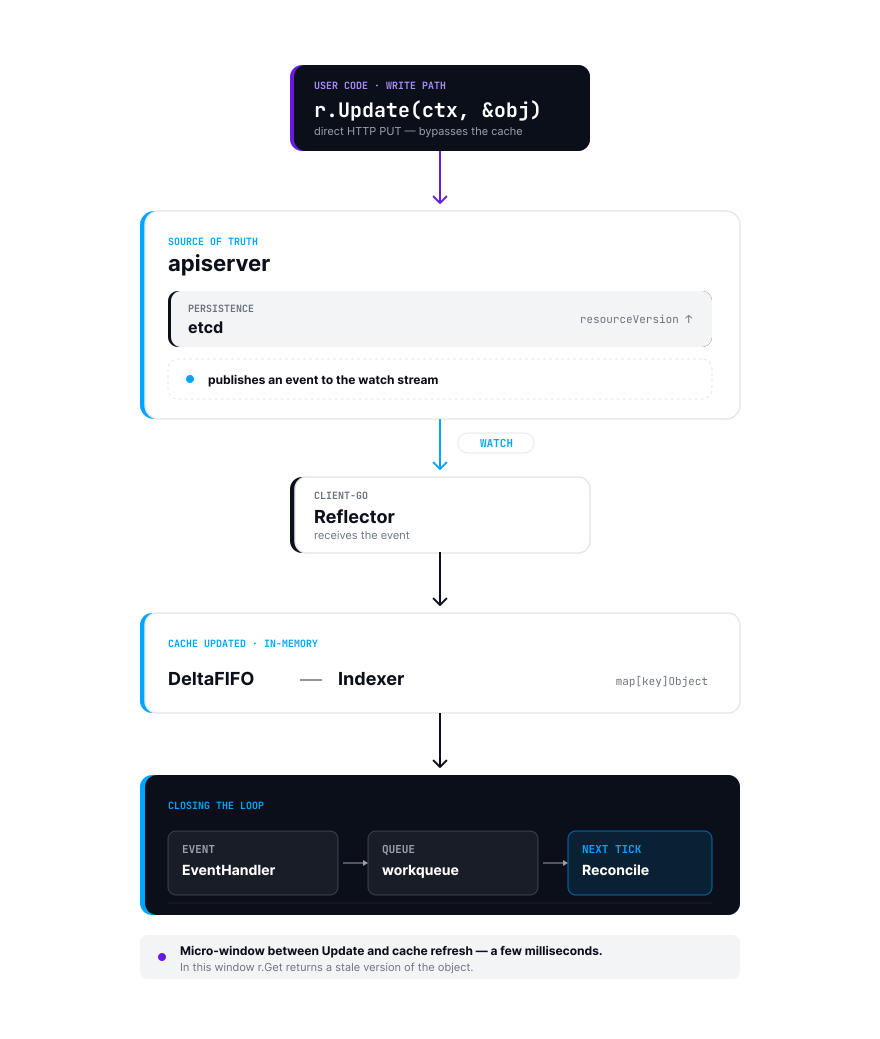
The "write → visibility" cycle now looks like this:
Write visibility diagram: client.Update to API server to watch event to cache
Between "you executed `Update`" and "the cache reflects the new state" there is a window —
usually milliseconds, but with no guaranteed upper bound. Inside that window, an `r.Get` for the
same object returns the previous version. The next section is essentially a list of mistakes
that grow out of that window.
## Common mistakes that everyone makes
### Mistake 1: expecting read-after-write
A familiar pattern:
```go
obj.Spec.Replicas = ptr.To(int32(5))
if err := r.Update(ctx, &obj); err != nil {
return ctrl.Result{}, err
}
// re-read and confirm it is now 5
var fresh appsv1.Deployment
_ = r.Get(ctx, key, &fresh)
fmt.Println(*fresh.Spec.Replicas) // surprise: 3
```
This is not a `controller-runtime` bug. It is a property of an eventually consistent system:
the cache catches up asynchronously, through the watch.
The right pattern is to never rely on instant freshness. `Reconcile` must be idempotent and
must always look at the current state. If it does not match the desired state, the next
reconcile fixes it. You do not need to "wait 100ms" or "re-trigger". You need to write the
logic so that one or two extra invocations break nothing.
If a stale read is a genuine correctness problem for you, a live read does not fix it — a
concurrent write can be mid-commit anyway. See the
[controller-runtime FAQ](https://github.com/kubernetes-sigs/controller-runtime/blob/820ed1a84f67c2f5c4ee4a104bc6c00faddb1384/FAQ.md#q-my-cache-might-be-stale-if-i-read-from-a-cache-how-should-i-deal-with-that)
for patterns that do.
### Mistake 2: `DeepCopy` and who owns the memory
To make sense of this, a quick word on event mechanics inside a controller. When you register
a source via `Watches(...)`, two layers sit between the indexer and your `Reconcile`:
- **Predicate** — the filter. It looks at an event (`CreateEvent`, `UpdateEvent`,
`DeleteEvent`, `GenericEvent`) and decides whether to pass it through.
- **EventHandler** — the transformer. It receives the object and turns it into one or more
`ctrl.Request` values that go into the workqueue. The classic
`EnqueueRequestForObject` enqueues the `namespace/name` of the current object.
Here is the critical part. Predicates and handlers receive **the same objects that live in
the informer's shared store**. The same `*corev1.Pod` is seen by every controller subscribed
to Pods.
Because Go has no immutable structs, nothing prevents you from doing
`pod.Labels["foo"] = "bar"` directly inside a handler — and that Pod is the one in the store.
Raw `client-go` listers have always worked this way; `ThreadSafeStore`'s own documentation puts
it bluntly: you must not modify anything returned by `Get` or `List` as it will break the indexing
feature. Patch a status "for convenience" in a handler and you break the world view of an
unrelated controller next door.
The cache-backed client from `controller-runtime` shields you from that on the read path: `Get` and
`List` deep-copy by default, and have since its earliest releases. You can opt out with
`UnsafeDisableDeepCopy`, which is named that way on purpose. The event path is not shielded —
there is no `DeepCopy` anywhere between the informer and your predicate. The simple rule:
- Anything you receive from `r.Get` / `r.List` is yours; mutate freely.
- Anything you receive in a `Predicate` or an `EventHandler` is shared, not yours. If you
must mutate it, call `obj.DeepCopy()` first; otherwise you are silently corrupting the
cache for every other controller subscribed to the same type.
A concrete review heuristic: if `predicate.Funcs{UpdateFunc: ...}` or
`handler.EnqueueRequestsFromMapFunc(...)` contains expressions like
`e.ObjectNew.SetLabels(...)` or `obj.Status.X = Y`, stop and ask whether a `DeepCopy` is
missing before that mutation.
### Mistake 3: resync is not relist
An informer has a resync period (`cache.Options.SyncPeriod`, 10 hours by default in
`controller-runtime`), and many people read it as meaning: _rebuild the cache from the API
server every n hours, fetching every resource once again_.
It does not. A resync does **not** perform a **list**. It _re-emits_ everything currently in
the indexer back through the delta queue, and the informer dispatches an update per object,
calling `OnUpdate(old, old)` for each one. This is for controllers that manage state outside
the Kubernetes API (a cloud provider resource, for example): out-of-band changes produce no
watch event, and a periodic resync is the only way to notice them. It generates no traffic to
the API server.
One caveat before you rely on resync as a safety net: because both sides of the synthetic
update are the same object, predicates that compare old and new — such as
`GenerationChangedPredicate` — will drop it.
A real `relist` happens only in two cases: when the **watch** died with `410 Gone`, and when
you explicitly recreate the informer.
### Mistake 4: do not confuse `RequeueAfter` with a timer
A small note that often saves time. Sometimes you want to wait inside a reconciler — "we
just called the provider's API; if it is not ready yet, retry in a minute". The temptation is
to spin up `time.Sleep` or your own goroutine.
Resist it. `controller-runtime` already provides a built-in mechanism:
```go
return ctrl.Result{RequeueAfter: 30 * time.Second}, nil
```
The controller puts your `req` back into the workqueue with a delayed trigger 30 seconds out.
If a real event for the same object arrives within that window, the reconcile fires
immediately, without waiting for the timer (the key is deduplicated in the queue). This is
both cheaper and more correct than a hand-rolled timer: you do not hold a worker, and you do
not risk missing a real event.
## cache + index = almost SQL
Now you get to what is, arguably, the most useful capability of the cache — and the one most
controllers leave unused.
By default, a `List` from the cache looks like this:
```go
var pods corev1.PodList
_ = r.List(ctx, &pods)
for _, p := range pods.Items {
if p.Spec.NodeName == "node-1" {
// do something
}
}
```
It works — until the cluster has 50,000 Pods and reconciles run hundreds of times per second.
Then the loop turns slow: every trigger walks all 50,000 Pods under the store's read lock,
then deep-copies each one after the lock is released, doing O(n) work per reconcile, and it is
the walk, not the copying, that blocks writers into the store.
The Indexer in `client-go` can do much better. You declare up front which field you want to
index on:
```go
// Index by spec.nodeName for Pods
if err := mgr.GetFieldIndexer().IndexField(
ctx,
&corev1.Pod{},
"spec.nodeName",
func(obj client.Object) []string {
pod := obj.(*corev1.Pod)
if pod.Spec.NodeName == "" {
return nil
}
return []string{pod.Spec.NodeName}
},
); err != nil {
return err
}
```
Two things about that call are worth making explicit, because the tidy example hides
them behind a convention.
**The index name is arbitrary.** That second argument, `"spec.nodeName"`, is only a
string key the index is registered under. `controller-runtime` does not parse it as
JSONPath and does not check it against the object's schema — you could write `"by-node"`
or `"xyzzy"` and it would behave identically. The only rule is that the *exact same
string* comes back in `MatchingFields` at query time. Naming the index after the field it
happens to read is a readability convention, nothing more.
But remember: this only works for reads served from the cache.
**The indexed value is computed, not read.** The function returns whatever strings you
build; they need not be the verbatim contents of any single field. You can lowercase a
value, join several fields into one composite key, bucket a timestamp (the _time-bucket_
trick below does exactly this), or emit a string that appears nowhere in the object
literally. Whatever the function returns becomes a key in the inverted dictionary, and a
`MatchingFields` lookup for that exact key is what finds the objects again. The only
constraint is that the value has to be *derivable from the object you are indexing*.
What is an _inverted index_? The term comes from search engines. Normally you have
documents and each document has a list of words in it. "Inverted" means the relationship is
flipped: a dictionary in which the key is a word and the value is the list of documents that
contain it. Same idea here: the key is the value of a field (for example, `node-1`), and the
value is the list of object keys whose field has that value:
```
map["node-1"] = {"default/pod-a", "kube-system/pod-b", ...}
map["node-2"] = {"default/pod-c", ...}
```
What the indexer does:
- On every incoming event (`ADDED`, `MODIFIED`, `DELETED`), the indexer runs the object
through your indexing function, gets back the set of index keys, and updates the inverted
dictionary. If a Pod migrates from `node-1` to `node-2`, the `node-1` key loses its
reference to it and the `node-2` key gains one.
- By the time you call `List`, the index is **already current**. You do not pay for a
rebuild at query time — no scan over all objects, no dictionary reconstruction. All the
work was done up front, at the moment the object changed.
And now you can write:
```go
var pods corev1.PodList
_ = r.List(ctx, &pods,
client.MatchingFields{"spec.nodeName": "node-1"},
)
```
This is not "fetch the full list, then filter". It is a lookup in the inverted index → a
ready set of keys → a fetch of the corresponding objects. A different code path entirely.
The comparison to SQL is more accurate than it might look at first:
| SQL | controller-runtime |
|---|---|
| `CREATE INDEX idx_node ON pods(node_name)` | `IndexField(&Pod{}, "spec.nodeName", fn)` |
| `SELECT * FROM pods WHERE node_name = 'node-1'` | `List(&pods, MatchingFields{"spec.nodeName": "node-1"})` |
| `SELECT * FROM obj WHERE owner_uid = $1` | `List(&list, MatchingFields{"metadata.ownerReferences.uid": uid})` (requires an `IndexField` for that field) |
Note the last row: `MatchingFields` does **not** make magic out of thin air. For every field
you want to look up via `MatchingFields` you need a corresponding `IndexField` registered
during manager setup. Without one, `controller-runtime` rejects the query and returns
an error.
A few things worth keeping in mind:
- **Equality only.** No range queries, no `LIKE`, no sorts, no aggregates. If you need
"everything older than five minutes", either do a regular `List` and filter in code, or
use a _time-bucket_ trick: instead of indexing the precise `time.Time`, index a rounded
value (for example, `now.Truncate(5*time.Minute).Format(...)`). You can then select objects
by a specific window.
- **`MatchingLabels` is not an index.** Many people assume that since label-based lookups are
so common, there must be an optimization for them. There is not: `ThreadSafeStore` keeps no
separate label dictionary. The only indexes the cache has are the namespace index and the
field indexes you register yourself.
Two separate things follow, and they get conflated. The walk really is O(n): with no label
index, `List(..., MatchingLabels{...})` still visits every cached
object of that kind, or whatever subset the namespace or a field index already narrowed it
to. But the selector is evaluated *before* the deep copy, so objects that do not match are
skipped without ever being copied. Against 50,000 Pods with ten matches, that is 50,000
cheap comparisons and ten expensive copies — not 50,000 copies. Which is why a
label-filtered `List` is still much better than fetching everything and filtering in your
own code afterwards: same walk either way, and the filtered version skips the copies you
were going to throw away.
So `MatchingLabels` is fine to use — just do not expect it to make the traversal cheaper.
To shrink the candidate set itself, use a namespace or a field selector backed by a
registered `IndexField`. To avoid holding the objects at all, filter at **cache population**
time via `cache.ByObject{Label: ...}` or `DefaultLabelSelector`, which pushes the selector
down to the **watch** itself — covered in the next section on selective caches.
- **An index costs memory.** An index maps each indexed value to a set of `namespace/name`
keys — not to copies of the objects. Cheap per object, not free, and still not a reason to
index everything in sight speculatively.
- **You can only index data that is in the object itself.** You cannot index a Pod by "has a
related PVC with such-and-such flag". Either store that bit in the Pod itself, or index
the PVC, not the Pod.
**Note:** An index is built at registration time and is populated as part of the initial
snapshot. By the time the first `Reconcile` runs, `List` with `MatchingFields` already works —
the index is not built lazily. (`Get` never consults a field index; it is a direct lookup by
store key.)
## Selective cache: do not pull the whole cluster into your controller
By default, an informer pulls every object of its type from every namespace. For Pod,
Secret, ConfigMap, and Event in a large cluster, that is a multi-gigabyte surprise
delivered on the first **list** at startup.
It hurts especially with:
- **Secrets**, because Helm stores release state in them (`helm.sh/release.v1.*`), and those
secrets are often a hundred kilobytes each.
- **`v1.Node`** objects, whose `status.images` field carries a list of every image that has
ever landed on the node — tens of kilobytes per node in busy clusters.
- **Events**, which can be very numerous and which you almost certainly do not need cached at
all.
In `controller-runtime`, caching policy lives in `cache.Options`, passed when constructing
the manager:
```go
mgr, err := ctrl.NewManager(cfg, ctrl.Options{
Cache: cache.Options{
ByObject: map[client.Object]cache.ByObject{
// Cache Secrets only from your own namespace, and only by label
&corev1.Secret{}: {
Namespaces: map[string]cache.Config{
"my-controller": {},
},
Label: labels.SelectorFromSet(labels.Set{
"app.kubernetes.io/managed-by": "my-controller",
}),
},
// Cache all Pods, but trim noise on the way into the store
&corev1.Pod{}: {
Transform: func(obj any) (any, error) {
pod := obj.(*corev1.Pod)
pod.ManagedFields = nil
return pod, nil
},
},
},
},
})
```
A subtle point: this is a **manager-level** setting and it affects **every controller in the
process** that reads the corresponding type. If you narrow the cache for Secrets to a single
namespace and another controller in the same binary needs all secrets in the cluster, that
controller will not see them. Before you tighten the scope, audit who else is reading
the type.
A short tour of the options:
- **`Namespaces`** restricts the visible scope. If your controller only manages its own
namespace, there is no reason to keep other people's objects in memory.
- **`Label` / `Field`** become parameters of the **watch** itself. The API server only sends
matching objects, saving network and memory.
- **`Transform`** is invoked before the object lands in the store. It is the perfect place to
drop `managedFields`, oversized `annotations`, or the binary `data` of ConfigMaps that
you do not need.
- **`DefaultLabelSelector` / `DefaultNamespaces`** apply the same restriction globally, when
every type needs the same scope.
**Caveat:** A selector limits what is **cached**, not what **exists**. If an object does
not match your selector, then as far as your controller is concerned, it does not exist in
either `Get` or `List`. This bites people: somebody mislabels a single Secret and then
spends half a day figuring out why their controller "cannot see it".
## Metadata-only: when `spec` and `data` are not needed
A separate pattern: you need to know that an object exists, but you do not need its `spec` or
`data`. Typical examples: a controller that waits for a Secret with a particular name to
appear but never reads it; one that counts PersistentVolume objects by the
`topology.kubernetes.io/zone` label; one that reacts to ConfigMap objects in a namespace
by name and does not care about contents.
**Caveat:** `PartialObjectMetadata` by definition gives you nothing from `spec` or
`status` — only `ObjectMeta`. So you **cannot** filter through it on `spec` fields (such as
a PersistentVolume's `storageClassName` or a Pod's `nodeName`); those fields do not
exist in the local copy. Everything covered by metadata-only is `labels`, `annotations`,
`ownerReferences`, `finalizers`, `creationTimestamp`, and the rest of `metadata`.
For this case there is `PartialObjectMetadata`:
```go
var list metav1.PartialObjectMetadataList
// controller-runtime infers the list shape from the variable type.
list.SetGroupVersionKind(schema.GroupVersionKind{
Group: "",
Version: "v1",
Kind: "Secret",
})
if err := r.List(ctx, &list, client.InNamespace("my-ns")); err != nil {
return err
}
```
Under the hood this is a separate watch that asks the API server for metadata only. The
store keeps such objects without `Data`, `Spec`, or `Status` — only `ObjectMeta`. For
Secrets the memory difference can reach an order of magnitude.
## APIReader: when the cache is not enough
`mgr.GetAPIReader()` returns a `client.Reader` that goes straight to the API server, around
the cache. When you actually need it:
- A one-off read of a resource for which you do not maintain an informer. Spinning up a watch
for a single operation is expensive.
- Reads **before `mgr.Start()`**, for instance during initialization. At that point the
cache-backed client fails with `ErrCacheNotStarted` rather than returning data.
- **Paginated traversal of large result sets** through `client.Continue`. The cache-backed
client rejects `Continue` with an explicit error, and honors `Limit` only as truncation — an
arbitrary N objects, not a stable "first N". For genuine pagination you need `APIReader` or
a direct client of your own.
The price is a real network request, and it is easy to underestimate: on top of the round trip
you pay to deserialize whatever comes back, which for a large collection is not cheap. So the
trade is less obvious than it looks — reading from the API server is not automatically cheaper
just because it avoids keeping objects in memory. Measure before you "optimize" a cached read
into a live one. One thing to avoid outright: do not build "look in the cache, and if missing,
fall back to the API" logic. That is exactly the split-brain pattern the cache is meant to
protect you from.
### Disabling the cache for a type entirely
If you do not need a local cache for a given type at all — say, the type is "fat", read
rarely, and the **list** + **watch** overhead is not worth paying — you can tell the manager not to
cache it. This is configured through `client.Options.Cache.DisableFor`:
```go
mgr, err := ctrl.NewManager(cfg, ctrl.Options{
Client: client.Options{
Cache: &client.CacheOptions{
DisableFor: []client.Object{
&corev1.Secret{},
},
},
},
})
```
With this configuration, `mgr.GetClient().Get(...)` and `List(...)` for Secret go straight
to the API server, bypassing the cache. No informer is started for that type, which means no
**list** at startup and no permanent memory pressure from a store. That also means no events:
nothing will trigger your controller when such an object changes. If you need those triggers,
pair the direct reads with a metadata-only watch. This is a more radical
alternative to `APIReader`: where `APIReader` is reached for ad hoc, individual requests,
`DisableFor` turns the cache off for the type wholesale.
Real-world projects use this: [external-secrets](https://github.com/external-secrets/external-secrets),
for instance, has flags that disable caching for Secrets and ConfigMaps, trading memory for
API traffic.
**Aside:** If you want to avoid a watch on the API server entirely, you can feed the
controller events from a source of your own design, bypassing **list** + **watch**. In
`controller-runtime` this is done with `WatchesRawSource` / `source.Channel`: you can wire
the controller to events from any place — an internal queue, a kubelet, a custom watch.
Niche, but a perfectly valid pattern when the API server should not be touched.
## Good practices
A short checklist worth running through before you ship a controller into a live cluster:
- **Constrain cache scope** (`Namespaces`, `Label`, `Field` selectors), especially for "fat"
types: Secret, ConfigMap, Event, Pod, Node.
- **Remember that a constrained cache acts as if everything outside its scope does not
exist.** A mislabeled object "disappears" with no error anywhere.
- **Add a `Transform`** for objects whose heavy fields you do not need —
`ManagedFields` alone consume a noticeable share of memory.
- **Add an `IndexField`** for every `List` that uses `MatchingFields`. Without a matching
index the query does not silently degrade — it fails with an error.
- **Do not mutate** objects you receive in an `EventHandler` or a `Predicate` without a prior
`DeepCopy`. Mutations to the store break neighboring controllers silently and persistently.
- **Make `Reconcile` idempotent.** It must behave correctly even if it is invoked five times
in a row with no real change.
- **Do not expect read-after-write** from the cache immediately after `Update`. The cache
lags during that window.
- **When the cache cannot serve a read** (initialization, deliberately uncached types), use
`APIReader`, not the regular client.
- **Use `PartialObjectMetadata`** for types where you only need metadata. It can save
gigabytes.
- **Do not call `mgr.GetClient()` before `mgr.Start()`.** The cache is not running yet, so
reads fail with `ErrCacheNotStarted` instead of returning data. Use `mgr.GetAPIReader()`
when you genuinely need to read during initialization.
- **For deferred actions, use `RequeueAfter`,** not `time.Sleep` and not your own goroutines.
## Wrapping up
In one breath:
- The cache in `controller-runtime` is not an optimization, it is the operating model. Under
the hood it is `Reflector` + a delta queue + `Indexer` — exactly the same primitives that
power Kubernetes itself.
- `r.Get` and `r.List` go to memory; `Create`, `Update`, `Patch`, and `Delete` go straight
to the API server. Feedback flows in through the watch.
- `IndexField` plus `MatchingFields` turn the cache into a near-complete query engine with
inverted indexes.
- `Namespaces`, selectors, `PartialObjectMetadata`, and `Transform` are the levers that
control how much memory and traffic you actually consume.
- `APIReader` bypasses the cache for the rare read the cache cannot serve — but it is not a
fix for staleness races; see the
[controller-runtime FAQ](https://github.com/kubernetes-sigs/controller-runtime/blob/820ed1a84f67c2f5c4ee4a104bc6c00faddb1384/FAQ.md#q-my-cache-might-be-stale-if-i-read-from-a-cache-how-should-i-deal-with-that).
And the single sentence to remember: `r.Get` inside a reconciler reads from memory, not from the
API server — not even the first time. The exceptions are the ones you opt into yourself:
`APIReader`, `Cache.DisableFor`, and unstructured reads. Once that becomes a reflex, half the
questions on controller code reviews answer themselves.